



What Do Capybaras Eat? Diet in the Wild, in Zoos, and the Poop Question
On
The short answer
Grass, aquatic plants, a little fruit, and one habit nobody wants to talk about. The capybara diet explained, with the plush menu to match.
What do capybaras eat? Mostly grass. A capybara is an herbivore, and its everyday menu is grasses and aquatic plants, with fruit, grains and tree bark added in the dry season when the good stuff runs low. An adult puts away roughly 3 to 4 kilograms of grass a day, about 6 to 8 pounds.
That is the short version. The long version has a few surprises, including one habit that people find either fascinating or unspeakable. We will get there. Gently.
What do capybaras eat in the wild
Capybaras live across South America, in every country except Chile, and they stay close to rivers, lakes, marshes and flooded grasslands. That choice of address is really a choice of menu. Water means lush grass on the banks and soft aquatic plants in the shallows, and both are on the daily list.
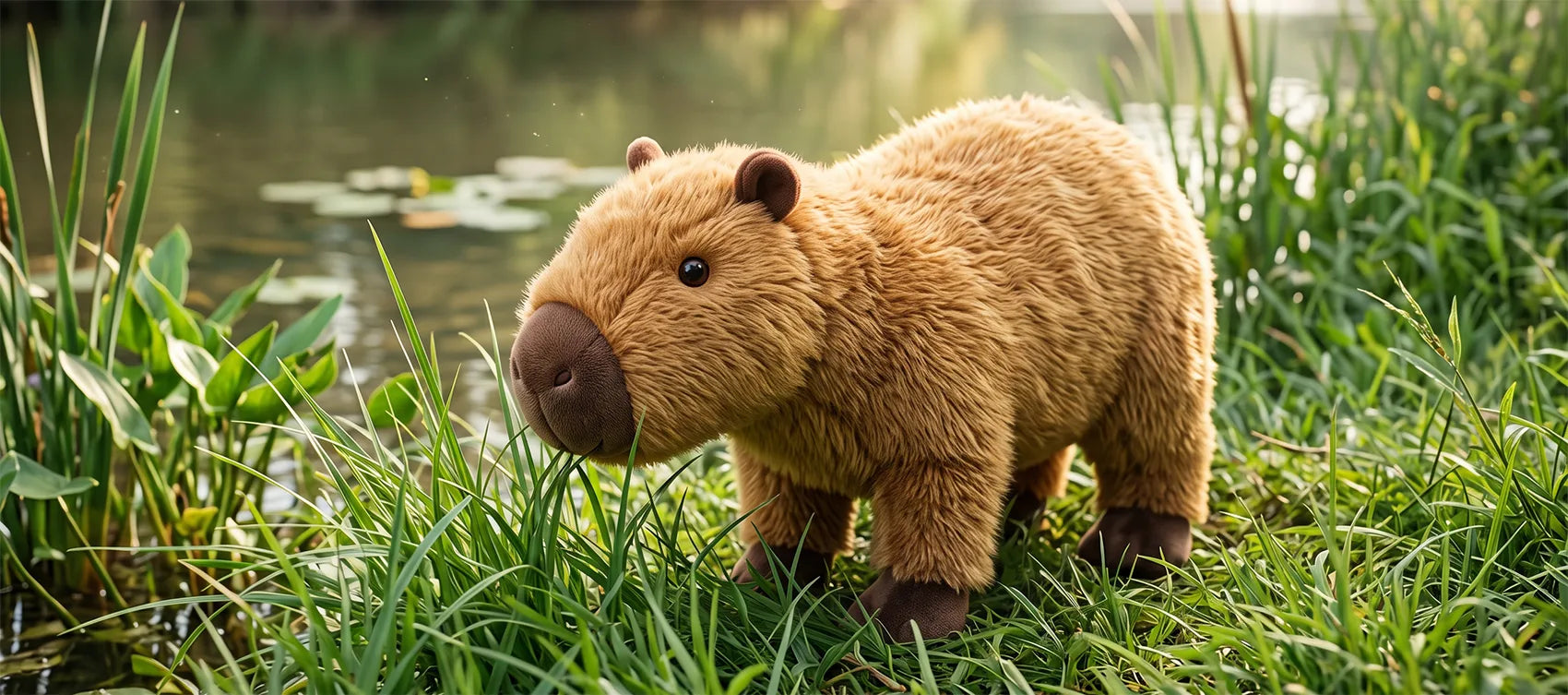
The wild capybara diet is simple and repetitive: graze, wade, graze again. When the dry season shrinks the water and the fresh grass with it, capybaras widen the menu to fruit, grains and tree bark. Even the animal's name points at the habit. It comes from a Tupi word usually translated as grass eater.
Herds of 10 to 20 animals graze together, and in the dry season groups of up to 100 can gather around whatever water is left. That is a lot of mouths in one meadow.
How much do capybaras eat
Roughly 3 to 4 kilograms, or 6 to 8 pounds, of grass per day for an adult. For an animal that weighs 77 to 146 pounds, that is a serious commitment to salad.
Two things make it possible. First, capybaras are commonly reported to spend a large part of the day grazing, so the intake is spread out rather than eaten in one sitting. Second, their teeth never stop growing. Grass is tough and wears teeth down, and continuous growth keeps the edges from wearing away to nothing.
So how much do capybaras eat? Enough to keep a lawn very tidy.
Do capybaras eat their own poop
Yes. Let us be plain about it, because it is normal and it is useful.
The habit is called coprophagy. Grass is full of cellulose, which is hard to break down in a single pass through the gut. Capybaras rely on gut bacteria to do the heavy work, and the first pass does not finish the job. So a capybara eats its own soft morning droppings and digests the same plant material a second time, with the bacteria's help. The second pass pulls out nutrients the first one missed.
Think of it less as eating waste and more as sending the meal back to the kitchen for a second course. From the capybara's point of view, nothing about it is strange. It is just breakfast.
What do capybaras eat in captivity
In zoos and sanctuaries the menu gets a little more organized. Keepers feed hay as the base, since it does the same job as wild grass and keeps those growing teeth busy. Pellets are part of the routine too. Vegetables bring variety, and some fruit rounds things out.
The balance still leans heavily toward grass and hay. Fruit and vegetables are the smaller part, and fruit in particular is handled as a treat. A capybara in a zoo is still, at heart, a grass eater with a very good publicist.
Anyone thinking about a pet capybara should know the grocery list is real: a lot of grass and hay, every day, for life. It is a far bigger commitment than the calm face suggests.
Do capybaras eat fruit and oranges
Yes to both. No answer to what do capybaras eat is complete without fruit. Capybaras enjoy it, and oranges and yuzu are commonly reported favorites in Japanese zoos, where keepers float citrus in the warm winter pools. The fruit is a treat, not a staple, and the animals seem to enjoy the warm water at least as much as the snack.
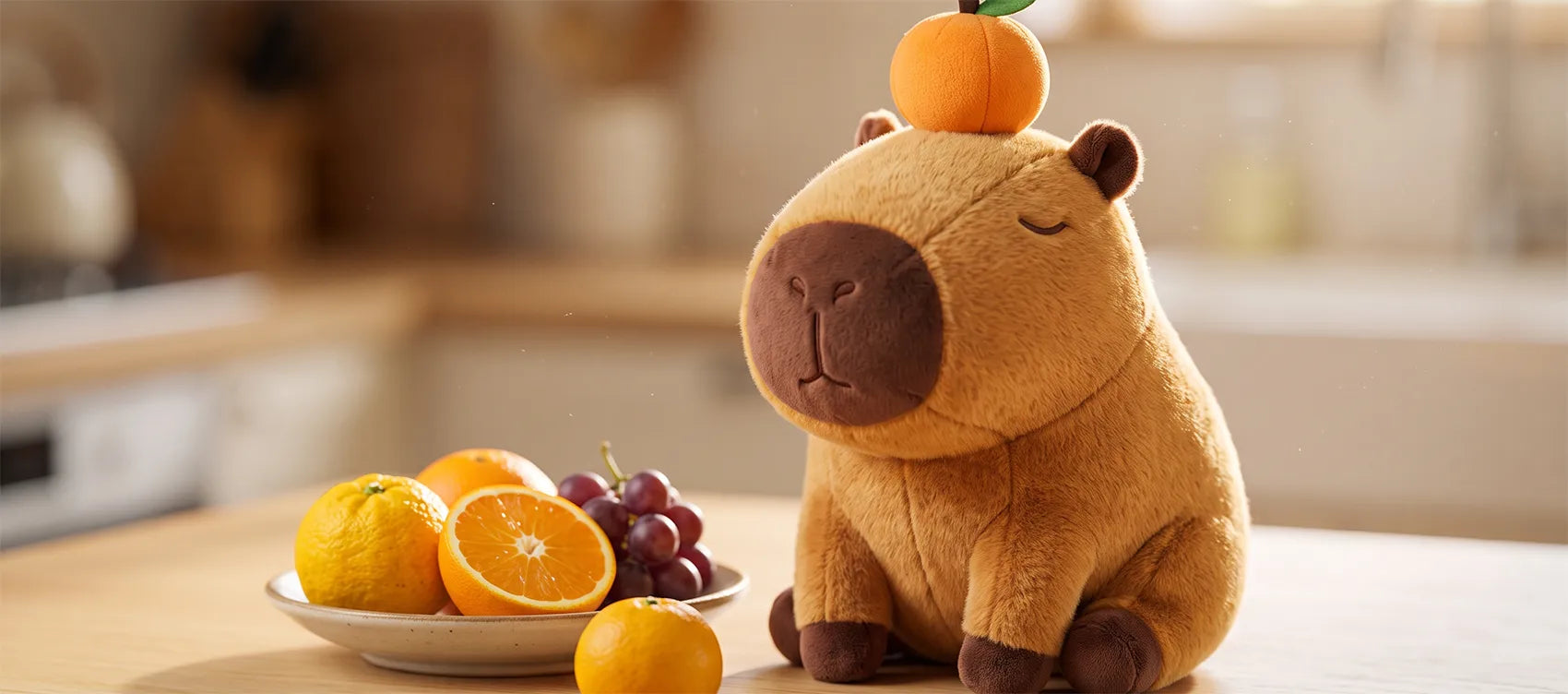
So do capybaras eat oranges? They do, in small amounts, and sometimes they wear them first. That is the origin of the famous photo and, eventually, of a whole style of plush. We told that story in full in our article on the capybara with orange on head.
The capybara menu, in plush form
Almost everything a capybara would eat, and several things it never would, exists in our catalogue as a plush.

Start with the fruit course, which a real capybara would approve of. The Sweet Berry Strawberry Capybara Plush wears a red berry hood that lifts off, in 5, 9 and 13 inches. The Summer Slice Watermelon Capybara Plush is a 12 inch pink capybara holding a red wedge you can pull away. The Ripe Pit Avocado Capybara Plush is green, 12 inches, with a pull out avocado under its chin. The Sweet Peel Banana Capybara Plush hugs a peeled banana at 9 inches, the Roasted Hazelnut Mini Capybara Plush holds a plush nut at 5 inches, and the Garden Patch Pink Capybara Plush cradles a soft turnip with its eyes stitched closed. The Little Sun Capybara With Orange On Head Plush has its orange sewn into its crown, which solves the one problem the zoo capybaras have.
Then there is the part of the menu no capybara has ever ordered. The Double Stack Capybara Burger Plush comes with a removable bun ring with lettuce, cheese and tomato, in 8 or 12 inches. The Butter Flake Capybara Croissant Plush is a smiling pastry with a capybara that lifts out of it. The Bun Wrap Capybara Hot Dog Plush is a 20 inch bolster with the capybara lying the full length of a golden bun. The Fresh Toast Slice Of Bread Capybara Plush pokes its head through a removable toast frame, and the Pearl Sip Capybara Drinking Boba Plush holds a foam topped bubble tea with a yellow straw. Herbivores, all of them, strictly in costume. You will find the whole food court in our dressed capybara plush collection.
And because this article promised to close the loop, there is the Cozy Nest Poop House Capybara Plush. A 12 inch capybara, a swirl shaped plush house, and a removable gingham bib. We are not going to explain the joke. You read the coprophagy section. You know.
All of these are collectibles for ages 14 and up, with soft plush fur. Care is simple: surface clean with a damp cloth and mild soap, air dry, no machine, no dryer.
Pick your plate
If you would rather keep a capybara that never needs feeding, our full capybara plush collection has the fruit course, the food court and the calm brown original. For a whole herd at once, the capybara plush sets put several friends in one box. Choose one, set it somewhere with a view, and let it graze on nothing at all.

Frequently asked questions
Do capybaras eat meat?
No. Capybaras are herbivores. Their diet is grasses and aquatic plants, with fruit, grains and tree bark in the dry season. In human care they get hay, pellets, vegetables and some fruit. Nothing on that list has ever had a face, unless you count the plush burger, and the plush burger does not count.
Is it normal for capybaras to eat poop?
Yes, and it is completely normal. The habit is called coprophagy. A capybara eats its own soft morning droppings so that gut bacteria can break down the cellulose from grass a second time. It recovers nutrients that the first pass through the gut missed. It is part of an ordinary capybara routine, not a sign that something is wrong.
Can capybaras eat oranges?
Yes, as a treat. Capybaras enjoy fruit such as oranges and yuzu, and zoos in Japan float citrus in their warm winter pools. Fruit is not a staple, though. Grass and hay stay at the center of the capybara diet, and fruit is the small, happy exception that occasionally ends up on a head.
What is a capybara's favorite food?
Grass, honestly. It would be more fun to say watermelon or oranges, and capybaras do enjoy fruit when they get it. But an adult eats around 6 to 8 pounds of grass a day, every day, and lives beside water. The favorite food is the one it never gets tired of.