




Why Are Capybaras So Chill? The Real Reasons Behind the Calmest Animal on Earth
On
The short answer
Big body, big family, easy exit and a quiet job: the real biology behind the calmest animal on Earth, plus the caiman myth, the bite question and the plush that copy the posture.
Why are capybaras so chill? The honest answer is not magic. A capybara is a big, social, herd-living grazer with very few reasons to panic. It spends its day eating grass beside the water, surrounded by family, with an escape route it can use in one step. Add a few years of very selective internet editing, and you get the calmest animal on Earth.
That reputation is mostly earned. Capybaras really are calm, tolerant and slow to react. But they are still wild animals, with serious teeth and their own boundaries. This article walks through the biology, the myths and the memes, and then shows you the plush that copy the posture: flat on the couch, eyes closed, in no hurry at all.
Why are capybaras so chill: the biology
Start with the size. The capybara is the largest living rodent, and it is not close. Adults measure 106 to 134 cm nose to rump (3.5 to 4.4 ft), stand 50 to 62 cm at the shoulder (20 to 24 in) and weigh 35 to 66 kg (77 to 146 lb). Females are slightly larger than males. Its closest well-known relative is the guinea pig, which tells you a lot about the shape and nothing at all about the scale. When you are, in most cases, the size of a large dog and built like a barrel, fewer things on the riverbank can bother you.

Then there is the herd. Capybaras live in groups of 10 to 20, and in the dry season those groups can swell to around 100 animals gathered around shrinking water. One dominant male, several females, the young and a few subordinate males all share the same patch of grass. A herd means many eyes and many ears, so no single capybara has to stay on high alert. It can relax because someone else is watching.
The water helps too. Capybaras are semi-aquatic, with webbed feet and eyes, ears and nostrils set high on the head, so they can float with only the top of the head showing. They can stay under for up to about 5 minutes, and they sometimes sleep in the water with just the nose out. When your safe place is always a few steps away, you do not need to run from every rustle in the reeds.
Finally, the job. A capybara eats roughly 3 to 4 kg (6 to 8 lb) of grass a day, mostly grasses and aquatic plants, plus fruit, grains and tree bark in the dry season. Grazing is slow, steady work with no chasing and no ambush. An animal whose whole day is eating and floating simply has less to be reactive about. That is the real answer to why are capybaras so chill: big body, big family, easy exit, quiet job.
Are capybaras friendly
Are capybaras friendly? Tolerant is the better word. In the wild they keep their distance from people in most cases, as most wild animals do, and they are not tame by default. What looks like friendliness on video is commonly a calm animal that has learned people are not a threat, often in a zoo or a sanctuary where it has been fed and handled for years.
So when people ask why are capybaras so friendly, the answer is that they are rarely aggressive and unusually tolerant of company, which reads as friendly to us. They do not seek hugs. They allow proximity. There is a difference, and the capybara is very clear about it.
Why do animals sit on capybaras
Why do animals sit on capybaras? Because the capybara lets them, and because it is a warm, wide, mostly stationary platform. Birds perch on capybaras to pick insects out of the fur, which is a good deal for both sides. Monkeys, turtles, ducks and other animals rest on or near them too, especially in zoos, where everyone shares one enclosure and the capybara is the calmest thing in it.

The store has its own version of this. The Pond Pal Duck On Head Capybara Plush comes with a yellow duckling perched on top, in a 9 in or 13 in size. It is the animals-sitting-on-capybaras joke, made in soft plush fur, and it does not mind being leaned on either.
Why don't crocodiles eat capybaras
Why don't crocodiles eat capybaras? They do, sometimes. The animal in the famous photos is usually a caiman, and caimans do eat capybaras, mostly young ones. The full predator list is long: jaguars, pumas, caimans and green anacondas, plus ocelots, harpy eagles and vultures that take the young.
The myth comes from those photos of adult capybaras lying beside caimans as if they were old roommates. Adults are large, alert, live in groups and flee to water, so a caiman often leaves them alone. The meal is not worth the effort. A photo of two animals ignoring each other is not proof of a friendship, just of a very calm calculation on both sides.
Are capybaras dangerous, and do they bite
Are capybaras dangerous? Rarely. They are calm, social and slow to anger. But do capybaras bite? Yes, when they feel they need to. A wild or badly kept capybara can bite hard with its large front teeth, which grow continuously and are worn down by grazing. Those teeth are built to cut grass all day, and they will cut other things too.
The sensible rule is the one that applies to every wild animal: admire from a distance, do not corner it, do not grab it. The chill is real, but it is not an invitation.
Why are capybaras so popular right now
Why are capybaras so popular? The animal did not change. The internet did. Capybaras are widely credited with becoming a worldwide favorite around 2022 and 2023, through memes and short videos, including the "capybara song" trend and the "Ok I pull up" meme. A creature that sits still, floats, and lets a duck stand on it is made for short videos.
There is also something in the timing. When everything online is loud, an animal that refuses to be loud stands out. The capybara became a mascot for doing less, and doing it well.
Borrow a little of that calm
You cannot keep a capybara on your sofa. You can keep a plush that copies the posture. Every plush at Plush Capybara is a collectible for ages 14 and up, and each one holds the pose a little differently: lying flat, a slow belly, closed eyes.

- The Calm Down Weighted Capybara Plush is 26 in long, carries 2.2 lb of inner weight, and lies flat. It is a comfort object, not a treatment.
- The Slow Breath Capybara Breathing Plush is 13 in, and its belly rises and falls. It takes 3 AAA batteries and starts with a press of the left foot. Watching it is very close to watching a real one nap.
- The Cloud Nine Giant Capybara Plush lies flat and round in smooth honey fur with no hard parts, from 16 in up to 31 in. It is the one to lie flat next to.
- The Nap Bubble Capybara Snot Plush is asleep, with a big blue bubble at its nose, in 5 in and 9 in. It is the whole thesis of this article in one face.
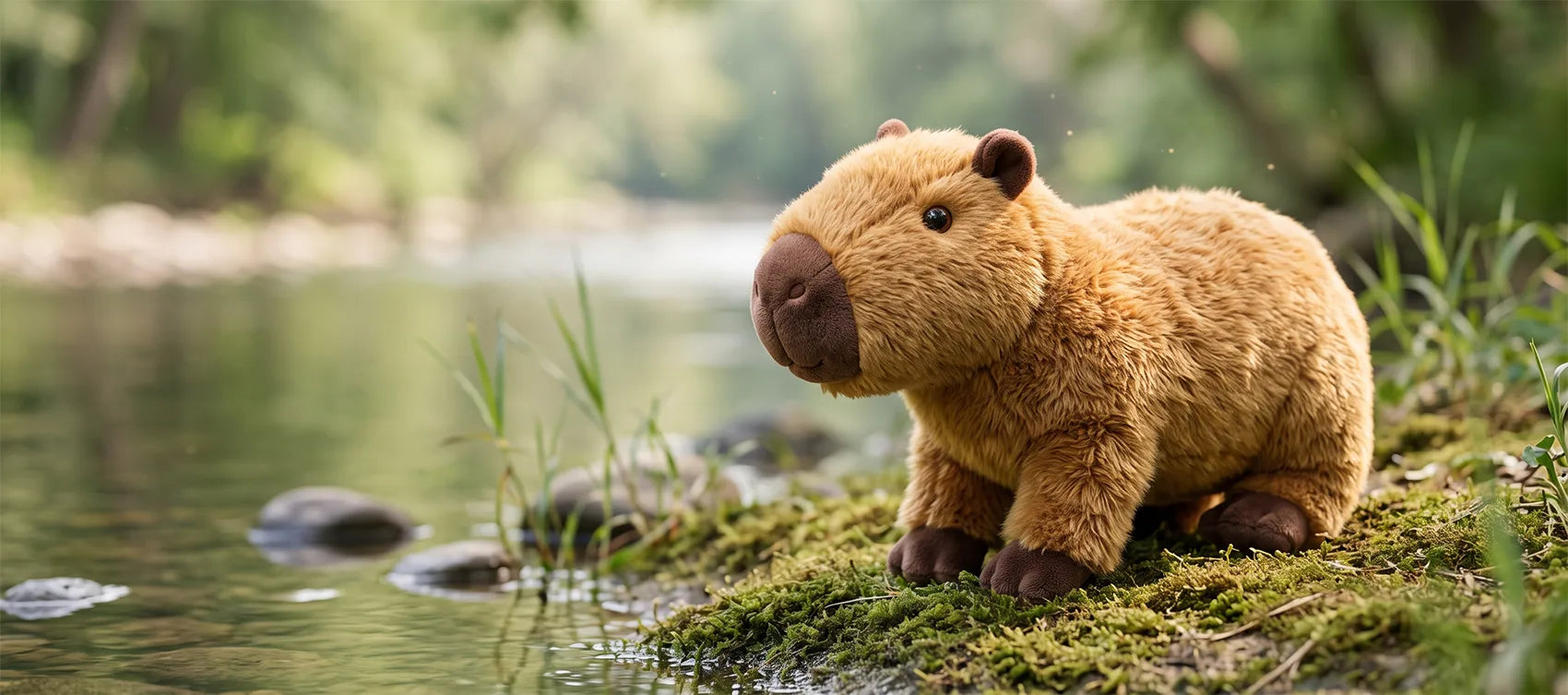
- The Riverbank Capybara Teddy Bear Plush stands on four legs in shaggy honey fur, 12 in, no hood and no costume. If you want the realistic one, this is it.
For the bigger, lie-down formats, browse the giant capybara plush collection. For the pocket-sized nappers, the mini capybara plush range has the smallest sleepers in the store.
Take the posture home
Now you know why are capybaras so chill, and the plush part is simpler: pick the pose you like best. Browse the full capybara plush collection to find the napper, the breather or the one with the duck, or go straight to the giant capybara plush range if you want one big enough to lie flat beside. Pick the one that looks like it has never been in a hurry. That is the whole point.
Frequently asked questions
Are capybaras friendly to humans?
They are tolerant rather than affectionate. Wild capybaras keep their distance and are not tame by default. Capybaras in zoos and sanctuaries can be very calm around people they know, which is where most of the friendly videos come from. Treat every capybara as a wild animal, keep your hands to yourself, and let it decide how close it wants to be.
Do caimans eat capybaras?
Yes, especially the young. Caimans share the capybara's habitat and take capybaras when they can, mostly young ones. Adults are large, alert, live in groups and flee to water, so a caiman often does not bother. The photos of a capybara resting beside a caiman show a calm standoff, not a friendship. The idea that crocodiles never eat capybaras is a myth.
Do capybaras bite?
Rarely, but they can. A wild or badly kept capybara can bite hard with its large front teeth, which grow continuously and are worn down by grazing. Bites are uncommon because the animal is calm and would rather walk into the water than fight. Give it space, do not grab it, and it will keep its teeth for the grass.
When did capybaras become popular?
Capybaras are widely credited with becoming a worldwide internet favorite around 2022 and 2023, through memes and short videos, including the "capybara song" trend and the "Ok I pull up" meme. A large animal that floats, naps and lets ducks stand on it is easy to love and easy to share. The popularity is new. The calm is not.